cloud-run

Bambu Lab Store Filament Tracker

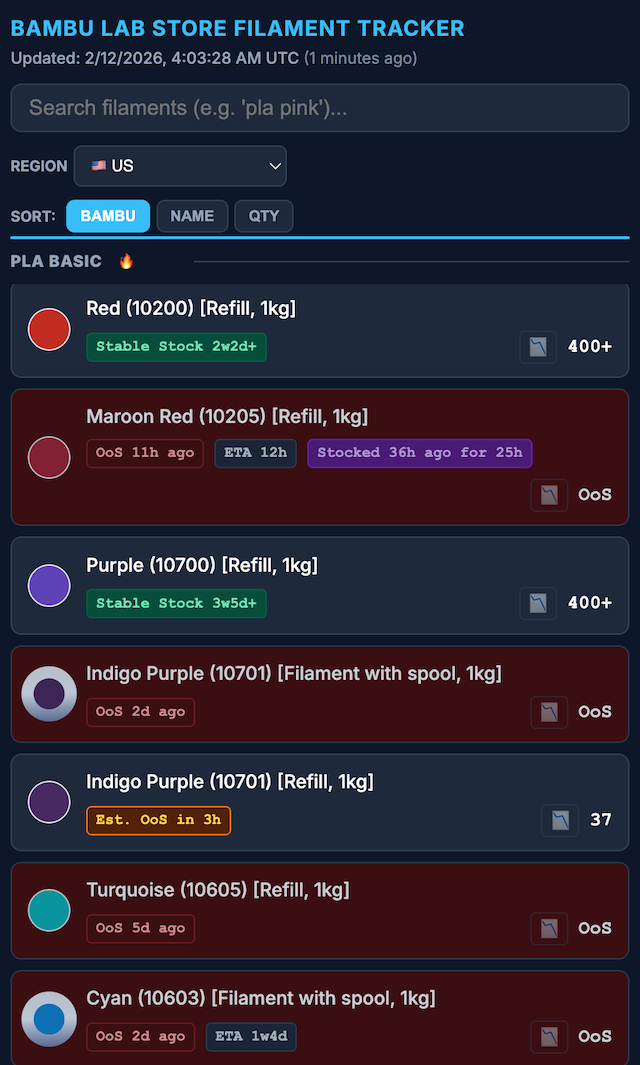
I’ve been running a Bambu Lab Store filament tracker at bbltracker.com.

bbltracker dashboard

I recently got into 3D printing. A lot of what I print is practical: last-millimeter adapters, things like robot vacuum ramps around the house, and other tiny fixes that make daily life less annoying.

Bambu Lab released the P2S, their flagship midrange printer, and I picked one up after hearing how polished their ecosystem is. People call them the Apple of 3D printers, and I can see why. The hardware is solid, but the software and ecosystem are really what make it shine.

There is also a bit of a format war around filament. Bambu sells filament with RFID tags that are not easy for third parties to mimic. The RFID flow makes loading filament easy and automatically applies Bambu-tuned profiles. Some people feel those profiles run too fast, but for my functional prints, they have worked great.

Where the frustration started

I like having color options, and color can be functional too. But stock has been rough for a while, even after the holiday season.

That rough stock situation (and the need for a tracker) is really a symptom of how popular Bambu has gotten, especially over the holidays:
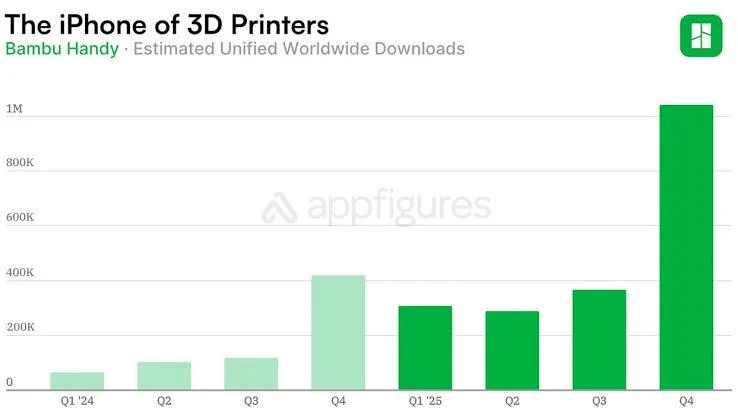
Handy chart showing Bambu popularity spike over the holidays

Source: Reddit comment

Then there is the constant bulk-sale mechanic on the Bambu Lab Store: buy 4+, get a strong discount, buy more, save more. In practice, that falls apart when the combinations you want are never all in stock at the same time.

At the time, the store UI also made this harder than it needed to be. Out-of-stock options were not clearly crossed out, so building a cart felt like guesswork.

That made me angry, but in a constructive way. So I built a tracker.

What the tracker does

At a high level, the tracker monitors store inventory over time, keeps historical snapshots, and renders a dashboard so I can quickly answer:

  • What is actually in stock right now?
  • What appears stable versus constantly draining?
  • What was the last major restock spike?
  • Are there ETA hints for restocks?
  • Is this likely to go out of stock soon?

I started with only the US store, then expanded to EU, CA, UK, AU, and Asia coverage.

I also reused a stock-quantity verification trick I had learned while documenting openpilot’s Toyota security key journey.

Building it fast (and keeping it moving)

I used a lot of Google Antigravity while building this. Web scraping is tedious work, and large language models helped a lot with iteration speed and the constant tweaks.

The codebase is not pretty in every corner, but LLMs have made it very workable to maintain and improve continuously.

Later, I added depletion-rate estimation so the tracker can make a rough guess about when something might go out of stock.

Things that happened after launch

After I released it and posted it on /r/BambuLab, a bunch of interesting things happened:

  • Bambu nerfed the original stock-count hole the tracker used.
  • For a while, counts were capped at 200 in the US view, which reduced visibility.
  • Later, that cap moved to 400 in the US store. Maybe my tracker’s utility was actually a factor in that decision? I do see traffic from China, where there is no Bambu Lab Store of the same codebase as far as I can see.
  • Bambu improved their UI and added clearer out-of-stock cross-outs.
  • I added more quality-of-life indicators, including “stable stock,” ETA context, and restock-spike visibility.
  • I added a GoFundMe and a nice patron funded a custom domain and hosting for the tracker.

Backend at a glance

Keeping this online reliably has mostly been a deployment and operations problem:

If you print a lot and buy filament in batches, this has been much better than manually refreshing product pages and hoping for the best.

8:10 pm / Bambu , Filament , Duckdb , Typescript , Cloud run , Cloudflare pages

Cell Shield

I built https://cellshield.info to scratch an itch. Why can’t I embed a spreadsheet cell?

You can click on that badge and see the sheet that is the data backing the badge.

It is useful for embedding a cell from an informal database that is a Google Spreadsheet atop of some README, wiki, forum post, or web page. Spreadsheets are still how many projects are managed and this can be used to embed a small preview of important or attention grabbing data.

It is a simple Go server that uses Google’s API to output JSON that https://shields.io can read. Mix it in with some simple VueJS generator front-end to take public spreadsheet URLS and tada.

I picked to base my implementation on shields.io’s as they make really pretty badges and have a lot of nice documentation and options.

I run it on Cloud Run to keep the costs low and availability high. It also utilizes Google’s implementation of authorization to get access to the Sheets API.

The badge generator web UI can also make BBCode for embedding (along with modern Markdown and so on).

I’ve already used it for this and that. The former outputs a running bounty total and the latter is community annotation progress.

A major Game Boy development contest is using it labels to display the prize pool amount: https://itch.io/jam/gbcompo21

Why I built this?

I built it for the Comma10K annotation project. I contributed the original badge which attempted to use a script that was used in the repo to analyze the completion progress. Unfortunately, this kept on diverging from the actual progress because the human elements kept changing the structure and organization and I had the badge removed. The only truth is what was on the spreadsheet.

Completion Status

Popularity

Compared to my other projects, I don’t think the popularity will be too good for this project though. I think it might have a chance to spread via word of mouth but it’s not everyday that a large public collaborative project is born with a Google Spreadsheet managing it. The name isn’t that great either as it probably conflicts with anti-wireless hysteria. Also, it’s not like there’s an agreed upon community of Google Spreadsheet users to share this knowledge with.

I also shamelessly plugged it here but I think the question asker might be deceased:

https://stackoverflow.com/questions/57962813/how-to-embed-a-single-google-sheets-cells-text-content-into-a-web-page/68505801#68505801

At least it was viewed 2,000 times over the last two years.

Maintenance

It’s on Cloud Run. The cost to keep it running is low as it sometimes isn’t even running and the Sheets V4 API it uses was recently declared “enterprise-stable”. Because of this, it will be super easy to maintain and cheap to run. I don’t expect any more than $2 a month.

6:47 pm / Google spreadsheets , Markdown , HTML , Golang , Cloud run , Bigquery , Gcp

GitHub Wiki SEE: Search Engine Enablement

I built this in March, but I figure I’ll write about this project better late than never. I supercharged it in June out of curiosity to see how it would perform. It’s just a ramble. I am not a good writer but I just wanted to write stuff down.

TLDR: I mirrored all of GitHub’s wiki with my own service to get the content on Google and other search engines.

If you’ve used a search engine to search up something that could appear on GitHub, you are using my service.

https://github-wiki-see.page/

Did you know that GitHub wikis aren’t search engine optimized? In fact, GitHub excluded their own wiki pages from the search results with their robots.txt. “robots.txt” is the mechanism that sites can use to indicate to search engines whether or not to index certain sections of the site. If you search on Google or Bing, you won’t find any results unless your search query terms are directly inside the URL.

The situation with search engines is currently this. For example, if you wanted to search for information relating to Nissan Leaf support of the openpilot self-driving car project in their wiki, you could search for “nissan leaf openpilot wiki”. Unfortunately, the search results would be empty and would contain no results. If you searched for “nissan openpilot wiki”, “https://github.com/commaai/openpilot/wiki/Nissan" would show up correctly because it has all the terms in it. The content of the GitHub wiki page is not used for returning good results.

[... 1,550 words]

6:12 pm / Github , Wiki , Seo , Rust , Cloud run , Bigquery , Gcp

GitHub Wiki SEE

https://github-wiki-see.page/

A project to get GitHub Wikis indexed by Google Search.

Explanation is right on the front page.

If a search engine can’t see it, it may as well be invisible.

Long-term project involving Rust, BigQuery, Cloudflare Workers, and lots of random hosting.

Probably one more the more visited sites on the internet and a continous effort to keep costs low.

Has caused GitHub to revisit their policy on a limited subset of Wikis meeting some criteria.

Will continue until all Wikis are indexed even if they are publically editable or don’t meet some star count criteria.

Personally, I just got really dismayed all this documentation I was doing on a Wiki wasn’t visible to Google. Then I realized it was a good idea to make it visible. Then I realized others don’t realize it was invisible at all. This was a problem.

12:00 am / Github , Wiki , Seo , Rust , Cloud run , Bigquery , Gcp , Flyio , Cloudflare